

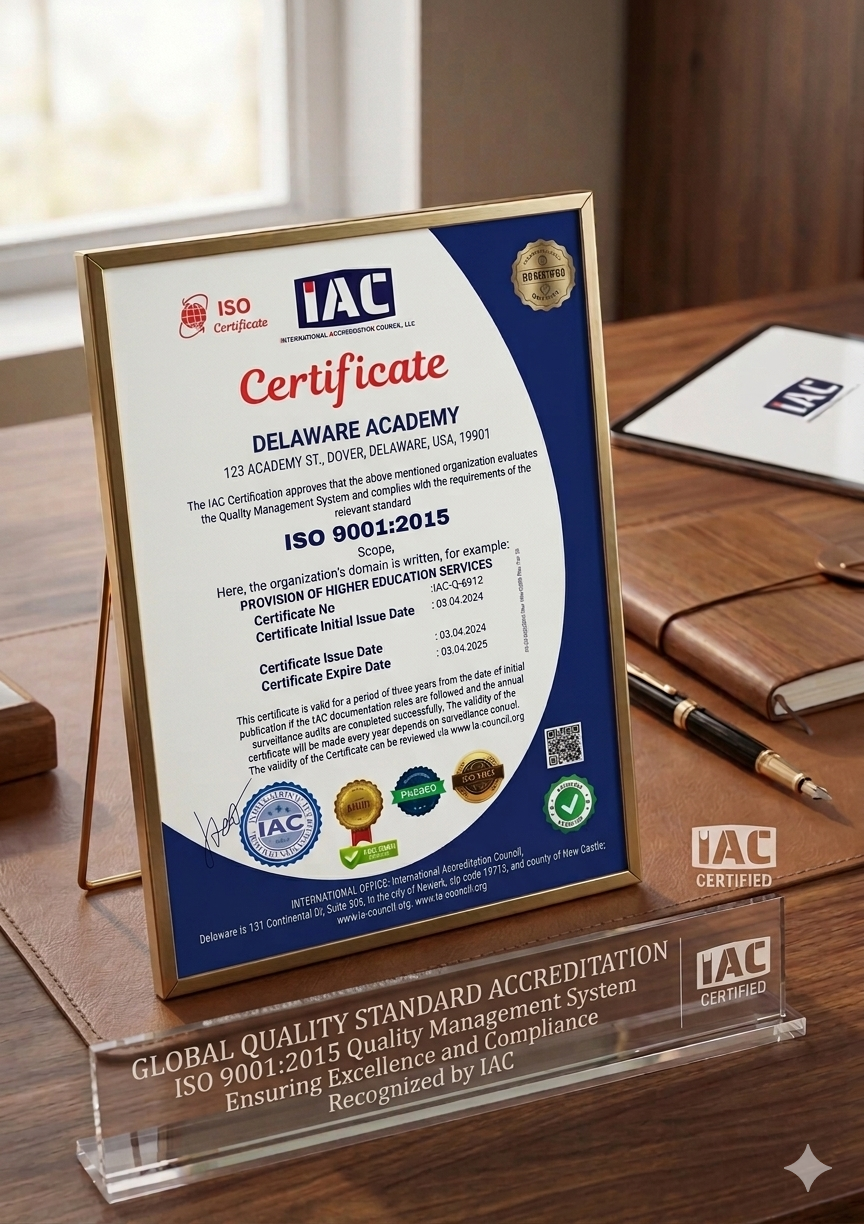
In an era where supply chains are global, customer expectations are instant, and quality is non-negotiable, how does your business prove it is truly “world-class”? The answer has remained consistent for nearly four decades: ISO 9001.
As the world’s most recognized Quality Management System (QMS) standard, ISO 9001 isn’t just a certificate to hang on the wall; it is a strategic blueprint for operational efficiency, risk management, and sustainable growth. However, the standard is evolving. With the draft of ISO 9001:2025 (DIS) now released and the final publication expected in late 2026, there has never been a more critical time to align your organization with the latest global benchmarks.
This guide explores the immense value of ISO 9001 certification, the significant updates on the horizon, and the exact steps your organization must take to secure its competitive advantage. For organizations ready to take the leap, the International Accreditation Council (IAC)—headquartered in Delaware, USA—stands ready to guide you through the final, crucial steps of selecting a certified body.
What is ISO 9001? More Than Just a Quality Standard
At its core, ISO 9001 specifies requirements for a Quality Management System where organizations need to demonstrate their ability to consistently provide products and services that meet customer and regulatory requirements. Unlike specific product standards, ISO 9001 is a generic standard—applicable to any organization, regardless of its type, size, or the product or service it provides, from manufacturing and healthcare to IT and logistics.
The framework is built on several high-level principles:
- Customer Focus: Meeting and exceeding customer expectations.
- Leadership: Top management’s involvement is crucial for unity of purpose.
- Engagement of People: Valuing employees to enhance competence.
- Process Approach: Managing activities as interconnected processes.
- Improvement: Driving ongoing performance gains.
- Evidence-based Decision Making: Relying on data analysis.
- Relationship Management: Optimizing interactions with interested parties.
The Tangible ROI: Why Certification Pays for Itself
Some business leaders view ISO certification as a cost center. Data suggests the opposite. Recent research published in International Economics analyzed firms across 33 countries and found that ISO 9001 certification increases total sales by an average of 48.3%.
Here is how that value breaks down for certified organizations:
Market Access & Credibility: For many government tenders and corporate supply chains, ISO 9001 is not optional; it is an entry ticket. It builds immediate trust, signaling to potential partners that you operate a controlled, professional system.
Operational Efficiency: The standard forces you to look at waste, duplication, and errors. By implementing process mapping and risk-based thinking, companies typically see a significant reduction in operational costs and defect rates.
Customer Retention: When you have a system for capturing customer feedback and acting on it, satisfaction rises. Certification aligns your delivery with the client’s expectation, leading to repeat business.
Risk Management: The evolving standard places heavy emphasis on proactive management. Instead of reacting to failures, you identify opportunities and threats (via SWOT analysis) before they impact production.
The 2026 Revision: Are You Ready for the Update?
ISO standards are revised approximately every 7-10 years. The current version (ISO 9001:2015) is giving way to ISO 9001:2026. The Draft International Standard (DIS) was published in August 2025, with the final standard expected in September 2026 and a three-year transition period to follow.
If you certify now, you will have a clear window to transition later, but ignoring the changes coming down the pipeline is a risk. Here are the key differences your organization needs to prepare for:
1. Digitalization & Remote Management
The new draft explicitly includes references to remote and hybrid work models, as well as the integration of digital technologies. Your QMS must now account for virtual audits, digital document control, and the use of automation/AI in quality assurance.
2. Ethics & Integrity
Clause 5.1 is expanding beyond just leadership accountability. It will now specifically require top management to promote a quality culture and ethical behavior. This moves compliance from a checklist item to a core leadership value.
3. Climate Change & Sustainability
Following global pressure, the new standard integrates ESG (Environmental, Social, Governance) factors. Organizations will need to consider how climate risks affect their ability to deliver quality products and services.
4. Separate Management of Risks AND Opportunities
Previous versions bundled risks and opportunities together. The 2026 update separates them into distinct clauses (6.1.2 for risks, 6.1.3 for opportunities), giving equal weight to proactive growth initiatives as to defensive risk mitigation.
The Roadmap to Certification: Timeline & Investment
Understanding the process demystifies the fear. The journey to ISO 9001 certification typically follows an eight-step lifecycle. While the timeline varies based on company size and complexity, most organizations complete the process in 3 to 12 months.
Phase 1: Foundation (Months 1-3)
- Gap Analysis: Compare your current processes against the ISO 9001 requirements. This diagnostic maps out exactly what is missing.
- Training: Key stakeholders and internal auditors receive training on the PDCA cycle and process approach.
Phase 2: Implementation (Months 3-6)
- Documentation: Develop your Quality Manual, Quality Policy, and necessary procedures (work instructions, flowcharts).
- System Activation: Roll out the new processes. This is often the longest phase, as employees must adapt to new workflows.
Phase 3: Internal Validation (Month 6-8)
- Internal Audit: Your trained staff conduct mock audits to find non-conformities before the external body arrives.
- Management Review: Top management reviews KPI data, audit findings, and customer feedback to ensure strategic alignment.
Phase 4: The Certification Audit (Month 8-12)
- Stage 1: The Certification Body reviews your documentation to ensure you are ready for the deep dive.
- Stage 2: Auditors visit your site (or conduct a remote audit) to verify that your QMS is actually working in practice. They interview staff and review records.
- Issuance: Once non-conformities are closed, the certificate is issued. It is valid for three years, with annual surveillance audits required to maintain it.
Cost Considerations
Budgeting for ISO 9001 requires looking at initial and ongoing costs. Generally, costs range from $5,000 to $40,000+ depending on size and complexity.
- Small Companies (1-25 employees): $5,000 – $10,000 (Includes gap analysis, basic training, and audit fees).
- Mid-Size (26-100): $10,000 – $20,000.
- Large (100+): $20,000 – $40,000+.
- Ongoing Maintenance: Expect to spend roughly $3,000 to $7,000 annually for surveillance audits.
While these figures represent the financial investment, many organizations find that the operational savings gained from reduced waste and errors recoup this cost within the first year.
Your Next Step: Contact the International Accreditation Council (IAC)
Navigating the complex landscape of ISO 9001:2026 requires a trusted partner. The difference between a certificate that gathers dust and a QMS that drives revenue lies in the integrity of the accreditation body.
The International Accreditation Council (IAC), headquartered in Delaware, USA, represents the gold standard in conformity assessment. Unlike generic consultants who simply “help you pass a test,” the IAC works with a network of accredited Certification Bodies (CBs) that adhere to the strictest international guidelines.
Why choose the IAC pathway?
- Global Recognition: IAC-accredited certificates are accepted in international supply chains without friction.
- US-Based Integrity: With its legal headquarters in Delaware, the IAC operates under a robust US legal framework, ensuring transparency and accountability.
- Integrity: We ensure the audit process is rigorous, protecting your brand’s reputation.
- Future-Proofing: IAC bodies are already integrating the 2026 DIS changes into their audit protocols, ensuring you aren’t certified to an outdated standard.
Ready to Transform Your Quality Management?
Do not let bureaucracy hold your business back. Whether you are a startup aiming for enterprise clients or a multinational looking to harmonize processes, ISO 9001 is your roadmap to excellence.
Contact the International Accreditation Council (IAC) today.
Visit our official website to verify your eligibility, find a certified local partner, and download the latest whitepaper on the ISO 9001:2026 transition.
Take the first step toward global credibility. Secure your future. Get ISO Certified with IAC – Delaware, USA.
Hi, this is a comment.
To get started with moderating, editing, and deleting comments, please visit the Comments screen in the dashboard.
Commenter avatars come from Gravatar.